_edited_edited_pn.png)
Types of Car Wheels Explained: Steel, Aluminium, Magnesium and Carbon Fibre

Updated: Sep 20
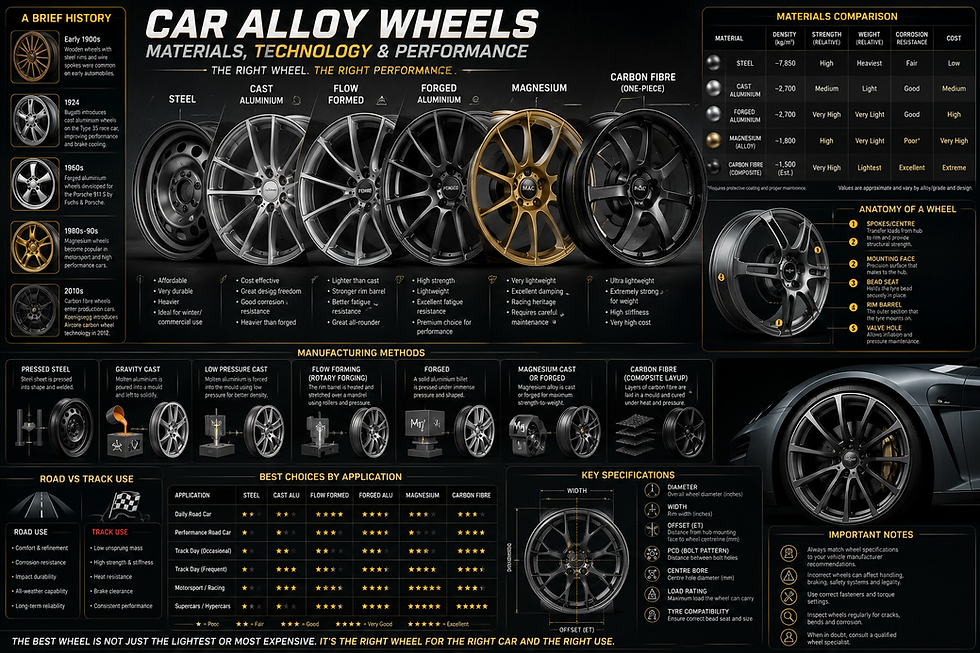
Car wheels are available in steel, cast aluminium, flow-formed aluminium, forged aluminium, magnesium and carbon-fibre constructions. Each material and manufacturing process offers a different balance of weight, strength, stiffness, durability, cost and repairability. This guide explains how the principal wheel types are manufactured, their history and which designs are best suited to road, performance and motorsport use, types of car alloy wheels :
The Correct Terminology: Wheel, Rim and Alloy and types of car alloy wheels
The terms wheel, rim and alloy are often used interchangeably, but they do not technically describe the same thing.
The wheel is the complete structural component fitted to the vehicle hub. It includes the centre, spokes, mounting face, bead seats and outer rim sections.
The rim is technically the outer part of the wheel on which the tyre is mounted. However, in normal conversation, people frequently use “rim” to describe the entire wheel.
An alloy is a metallic material containing two or more elements. Steel is therefore an alloy because it is primarily a combination of iron and carbon. Nevertheless, the automotive term alloy wheel normally refers to a lightweight non-ferrous wheel made predominantly from aluminium or magnesium.
Fuchs correctly distinguishes the complete wheel from the rim and explains that its forged aluminium wheels use an alloy containing aluminium with controlled quantities of magnesium, silicon, manganese, titanium and other elements.
Are Car Wheels Made From Iron?
Complete modern passenger-car wheels are not normally manufactured from cast iron.
When somebody refers to an “iron wheel,” they almost always mean a steel wheel. Steel is an iron-based alloy, but it has mechanical properties and manufacturing characteristics that are very different from cast iron.
Pressed-steel wheels remain common in passenger, commercial, military and specialist vehicles. Modern wheel manufacturers generally classify their metallic products as steel or aluminium wheels rather than creating a separate cast-iron category. SAE wheel standards also distinguish ferrous wheel applications through established performance and fatigue-test procedures.
Cast iron is widely used for components such as conventional brake discs, but its density and impact behaviour make it unsuitable as the normal material for a complete modern road wheel.
Why Wheel Material Matters
A wheel must support the vehicle, retain the tyre, transmit acceleration and braking torque, resist cornering loads and survive potholes, kerbs, vibration and repeated fatigue cycles.
Its material also affects:
Unsprung mass
Rotational inertia
Steering response
Suspension control
Acceleration and braking response
Ride quality
Heat transfer
Corrosion resistance
Impact behaviour
Long-term fatigue life
Reducing wheel weight can allow the suspension to respond more effectively to changes in the road surface. Reducing mass towards the outer circumference can also lower rotational inertia, although the actual benefit depends on where the weight is removed rather than wheel weight alone.
Koenigsegg explains that reductions in unsprung and rotational mass can improve suspension response, acceleration, braking and agility. However, a lighter wheel is only beneficial when it retains sufficient stiffness, impact resistance and fatigue strength for the application.
A Brief History of Automotive Wheels
Early automobiles inherited wheel technology from bicycles and horse-drawn vehicles. They used wire-spoked wheels, wooden artillery-style wheels and wooden spokes with steel outer rims.
The Science Museum Group preserves examples of wooden artillery wheels manufactured for early motor cars, while Mercedes-Benz records early vehicles using wire spokes, wooden spokes and steel-rimmed wooden wheels.
As cars became heavier and faster, manufacturers adopted pressed-steel wheels because they could be produced economically in large volumes while providing reliable strength.
A major development arrived in 1924 when Bugatti used cast aluminium wheels on the Type 35 racing car. These wheels featured eight broad spokes, a removable rim and an integrated brake drum. Their lower mass and open design helped improve handling and brake cooling compared with many contemporary designs.
Forged aluminium later became important in high-performance production cars. During the 1960s, Porsche and Otto Fuchs developed a lightweight one-piece forged wheel for the Porsche 911 S. The design work began in 1965 and became one of the best-known performance wheels in automotive history.
Magnesium wheels became strongly associated with racing and high-performance cars, producing the popular expression mag wheels. The name later became incorrectly applied to many aluminium wheels that contained no meaningful quantity of magnesium as their main material.
Carbon-fibre wheels entered limited-production road and supercar applications during the twenty-first century. Koenigsegg introduced its one-piece hollow Aircore carbon wheel technology in 2012, while other manufacturers have since developed monoblock and hybrid carbon wheel systems.
Steel Wheels
A typical steel wheel consists of a pressed centre connected to a formed steel rim section.
Steel wheels remain popular because they are economical, durable and suitable for mass production. They are commonly fitted to entry-level passenger cars, vans, commercial vehicles, off-road vehicles and winter wheel packages.
Advantages of Steel Wheels
Steel wheels are generally less expensive than aluminium, magnesium or carbon-fibre wheels.
They can offer excellent durability in rough operating environments and are well suited to commercial, winter and utility applications. Their simple shapes can also be easier to clean when exposed to mud, salt and heavy contamination.
A steel wheel may deform under an impact rather than fracture immediately. However, this must not be interpreted as meaning every bent steel wheel is safe to straighten and reuse.
Disadvantages of Steel Wheels
Steel is comparatively dense, so a steel wheel may be heavier than a properly engineered aluminium or magnesium alternative.
Additional mass can increase suspension workload and rotational inertia. Steel wheels also provide less styling freedom because their centres are normally stamped from sheet material.
Poor surface protection can allow corrosion to develop, particularly around the bead seats, valve opening, mounting face and welded areas.
Best Uses for Steel Wheels
Steel wheels are particularly suitable for:
Commercial vehicles
Winter wheel sets
Utility and fleet vehicles
Rough-road environments
Cost-sensitive road applications
Certain off-road applications
They are generally not selected for high-end road or circuit cars where low mass, brake clearance and steering response are major priorities.
Aluminium Alloy Wheels
Aluminium alloy is the most common material used for modern road-car alloy wheels.
An aluminium wheel is not manufactured from pure aluminium. Other elements are added to control strength, toughness, heat-treatment response, corrosion resistance and manufacturing behaviour.
For example, the forged aluminium alloy described by Fuchs is approximately 97% aluminium, with controlled additions including magnesium and silicon. This is still an aluminium wheel, not a magnesium wheel, because aluminium remains the primary material.
Aluminium wheels can be produced through several different methods. The process is at least as important as the basic material description.
Cast Aluminium Wheels
Casting involves pouring or forcing molten aluminium alloy into a mould and allowing it to solidify.
Cast wheels dominate the road-car market because they permit complex designs at a reasonable production cost.
Gravity-Cast Wheels
In gravity casting, molten metal fills the mould mainly through gravity.
The process is relatively straightforward and economical. However, the wheel may require more material to achieve the required strength because controlling porosity and the internal structure can be more difficult than with advanced casting or forging methods.
A properly designed and manufactured gravity-cast wheel can still be entirely suitable for normal road use.
Low-Pressure-Cast Wheels
Low-pressure casting uses controlled pressure to move molten alloy into the mould.
This can improve mould filling and provide greater control over the solidification process. It is widely used for original-equipment and quality aftermarket wheels.
Low-pressure casting does not automatically guarantee a strong wheel. Alloy specification, heat treatment, mould design, quality control and structural design remain essential.
Advantages of Cast Aluminium
Cast aluminium wheels provide:
Good styling freedom
Moderate production cost
Useful corrosion resistance
Lower weight than many equivalent steel designs
A wide range of sizes and finishes
Disadvantages of Cast Aluminium
Cast material can contain pores or local defects if the process is poorly controlled.
To meet a required load rating, a cast wheel may need thicker spokes and sections than a forged wheel. This is why some large cast wheels can be surprisingly heavy.
A cast wheel should not be judged only by appearance. Two nearly identical designs can have very different mass, load capacity and fatigue performance.
Flow-Formed Wheels
Flow forming begins with a wheel blank, commonly produced by casting. The rim barrel is then heated and shaped over a mandrel using rollers and considerable pressure.
The process stretches and compresses the material in the barrel, allowing manufacturers to produce a thinner and lighter rim section with improved material characteristics.
BBS describes flow forming as a process in which the wheel blank rotates while hydraulic rollers form the heated rim area under pressure.
Flow Forming Is Not Full Forging
This distinction is important.
A flow-formed wheel is not automatically a fully forged wheel. In many products, the centre remains cast while the barrel receives the flow-forming treatment.
Terms such as flow forged, rotary forged and spun forged are sometimes used in marketing. The buyer should establish whether the complete wheel was forged or whether a cast blank received flow forming only in the rim area.
Advantages of Flow-Formed Wheels
Flow-formed wheels can provide a good compromise between:
Weight
Strength
Price
Road durability
Styling flexibility
They are often a sensible option for performance-road cars and occasional track use when produced by a reputable manufacturer.
Forged Aluminium Wheels
Forging forms solid aluminium alloy under extremely high pressure.
The material is compressed and shaped through several stages before the wheel is heat-treated and machined. The process creates a fine, controlled structure and avoids many of the pores associated with casting.
Fuchs uses press forces of up to 7,000 tonnes during its wheel-forging process. The company reports improved strength, fatigue resistance and toughness, allowing thinner sections and lower wheel mass than its comparable cast constructions.
Advantages of Forged Aluminium
A well-designed forged aluminium wheel can offer:
Lower weight
High fatigue strength
Good toughness
Thin structural sections
Precise machining
Increased brake clearance
Strong resistance to demanding road and track loads
Forged aluminium is one of the most practical premium materials for high-performance road cars because it combines low mass with established manufacturing and inspection methods.
Disadvantages of Forged Aluminium
Forged wheels are substantially more expensive to manufacture.
A forged wheel can still be damaged, cracked or overloaded. The word “forged” does not make a wheel indestructible, and a poor design is not automatically corrected by using a premium manufacturing process.
CNC-Machined and Billet Wheels
CNC machining describes how material is removed to create the final shape. It does not by itself describe the quality of the original material.
A wheel machined from a forged blank may have excellent properties. A wheel should not be considered equivalent to a fully forged product merely because it was CNC-machined.
Magnesium Alloy Wheels
Magnesium is the lightest commonly used structural metal and can permit extremely low wheel mass.
As with aluminium wheels, automotive magnesium wheels are manufactured from engineered alloys rather than pure magnesium. Additional elements and controlled processing are required to obtain the necessary strength, stability and corrosion resistance.
Magnesium-alloy wheels may be cast or forged.
Cast Magnesium Wheels
Cast magnesium wheels have been used extensively in historic motorsport and motorcycle racing.
They can be very light, but manufacturing quality, material grade, age, heat exposure and corrosion protection are especially important.
Older magnesium wheels should not be assumed safe simply because no visible cracks are present. Historic competition wheels may require specialist inspection because corrosion and fatigue can develop over time.
Forged Magnesium Wheels
Forging can produce a stronger and more consistent magnesium structure than basic casting, permitting extremely light road and competition wheels.
Modern magnesium wheels are not restricted to pure racing cars. Aston Martin, for example, uses road-homologated magnesium wheels on the Valiant to reduce unsprung mass and improve steering response and wheel control. Ford and other high-performance manufacturers have also applied magnesium wheels to road-legal performance programmes.
Advantages of Magnesium Wheels
Correctly engineered magnesium wheels can provide:
Very low mass
Low rotational inertia
Fast suspension response
Improved steering response
Useful vibration-damping characteristics
Strong performance potential for racing
Disadvantages of Magnesium Wheels
Magnesium wheels are expensive and require careful manufacturing, surface protection and inspection.
Damage to the protective finish must be treated seriously because exposed magnesium alloy can be vulnerable to corrosion. Cleaning products, repairs, refinishing and tyre-fitting procedures must be compatible with the wheel manufacturer’s instructions.
The reputation of magnesium as a highly flammable wheel material is often oversimplified. Modern automotive wheels use specialised magnesium alloys, not pure magnesium. Nevertheless, machining debris and fine magnesium particles require strict industrial fire-control procedures, and wheel repairs should only be undertaken by qualified specialists.
Best Uses for Magnesium Wheels
Magnesium is best suited to:
Dedicated racing cars
Track-focused road cars
Low-volume supercars
Applications where every kilogram of unsprung mass matters
Vehicles supported by proper inspection and maintenance programmes
For normal daily road use, forged aluminium is often the more practical balance of cost, durability and maintenance.
Carbon-Fibre Wheels
Carbon-fibre wheels use carbon reinforcement within a resin system to create a structural composite.
Unlike metal, whose properties are broadly similar in different directions, a carbon composite can be engineered by controlling fibre direction, layer sequence and local thickness.
There are two main automotive formats:
One-piece carbon-composite wheels
Carbon-hybrid wheels
One-Piece Carbon Wheels
A one-piece carbon wheel integrates the barrel, spokes and centre into one composite structure.
Koenigsegg’s hollow Aircore system is one example. The company introduced the technology in 2012 and reported a significant reduction in unsprung mass compared with its previous alloy wheels.
Carbon Revolution also supplies one-piece carbon-composite wheels for original-equipment road-car applications. These products are developed around automotive impact, fatigue, environmental and durability requirements rather than being cosmetic carbon components.
Advantages of One-Piece Carbon Wheels
Potential benefits include:
Very low mass
Reduced rotational inertia
High structural stiffness
Improved suspension response
Strong styling and aerodynamic opportunities
Disadvantages of Carbon Wheels
Carbon wheels are extremely expensive and require specialist manufacturing and inspection.
Impact damage may not behave in the same way as deformation in a steel or aluminium wheel. After a severe pothole strike, kerb impact or accident, inspection and replacement decisions must follow the manufacturer’s procedure.
Generic wheel-repair methods should not be applied to a carbon-composite wheel.
Carbon-Hybrid Wheels
A carbon-hybrid wheel combines a carbon-fibre rim or barrel with a separate forged aluminium or magnesium centre.
The components may be joined with specialist fasteners. This allows engineers to use carbon fibre in the outer barrel while retaining a metallic centre for mounting, spoke design and heat management.
Dymag describes carbon-hybrid designs using a carbon barrel with forged aluminium or magnesium centres, commonly assembled using lightweight fasteners.
Advantages of Carbon-Hybrid Wheels
A hybrid design can provide:
Lower barrel mass
Reduced rotational inertia
Greater centre-design flexibility
Replaceable individual components in certain approved designs
A balance of composite lightness and metallic centre stiffness
The manufacturer must approve any component replacement. Multi-piece construction does not mean parts from different brands or models can be combined safely.
Two-Piece and Three-Piece Metal Wheels
A two-piece wheel normally consists of a centre attached to a separate rim barrel.
A three-piece wheel commonly uses a centre, inner barrel and outer lip assembled with bolts and a sealing system.
These constructions offer flexibility in width, offset, finish and component replacement. They are popular in motorsport, bespoke road applications and high-end aftermarket builds.
However, additional joints and fasteners create more components that must be correctly engineered, assembled and maintained.
A multi-piece wheel is not automatically lighter or stronger than a one-piece wheel. The result depends on its material, design, fasteners, sealing method and load rating.
Titanium and Other Material Combinations
Complete titanium wheels are extremely uncommon in passenger cars.
Titanium offers excellent strength and corrosion resistance, but it is more expensive and denser than aluminium or magnesium. It is therefore more commonly used for specialist fasteners and hardware rather than complete road wheels.
Hybrid constructions may combine:
Carbon-fibre barrels
Forged aluminium centres
Forged magnesium centres
Titanium fasteners
Steel inserts or mounting components
Aluminium-magnesium-silicon alloys
It is important not to confuse an aluminium alloy that contains a small percentage of magnesium with a magnesium wheel. The classification depends on the principal material.
Monoblock Does Not Mean Forged
The term monoblock simply means that the main wheel structure is manufactured as one piece.
A monoblock wheel may be:
Cast aluminium
Flow-formed aluminium
Forged aluminium
Forged magnesium
Carbon composite
Monoblock describes the number of principal structural pieces, not the manufacturing process.
Road Wheels Versus Track Wheels
A road wheel and a racing wheel face different requirements.
A road wheel must survive potholes, kerbs, water, salt, temperature changes, long service intervals and a wide variety of tyre loads.
A racing wheel operates in a more controlled environment but may experience severe cornering forces, brake temperatures, kerb strikes and repeated tyre changes.
Best Choices for Normal Road Use
For most road vehicles, the most suitable choices are:
Original-equipment steel wheels
Quality cast aluminium wheels
Quality flow-formed wheels
Forged aluminium wheels
The decision should be based on correct specifications and certification rather than material alone.
Best Choices for High-Performance Road Use
Forged aluminium often provides the best overall compromise for powerful road cars and supercars.
It offers low mass, high strength, good corrosion resistance and established repair and inspection procedures.
Road-homologated magnesium and carbon wheels can provide additional performance benefits but at much higher cost and with more specialised maintenance requirements.
Best Choices for Regular Track Use
For frequent track use, a properly engineered forged aluminium wheel is normally the safest practical starting point.
Forged magnesium can provide further weight reduction for professional or highly focused applications. Carbon and carbon-hybrid wheels may also be effective when specifically approved for the car, tyre, brake system and circuit use.
Race-team inspection schedules should always take precedence over assumptions about material superiority.
Best Choices for Competition
Competition wheel selection depends on:
Technical regulations
Vehicle weight
Aerodynamic load
Tyre construction
Brake temperature
Kerb usage
Circuit surface
Race duration
Required pit-stop procedure
Wheel life and inspection schedule
A lighter wheel can improve performance, but a wheel that flexes excessively, overheats, cracks or cannot tolerate circuit kerbs will make the vehicle slower and less reliable.
Does a Bigger Wheel Improve Performance?
Not necessarily.
A larger diameter can provide additional brake clearance and may sharpen steering response by allowing a lower-profile tyre.
However, increasing diameter can also add mass, increase rotational inertia and reduce tyre sidewall compliance. This may make the car less comfortable and less capable of maintaining tyre contact on uneven roads.
A larger wheel fitted with the wrong tyre can also increase the overall rolling diameter, alter gearing, affect ride height and interfere with ABS, traction-control and stability-control calibration.
For circuit use, the lightest wheel is not always the largest or most visually aggressive one. The correct combination must consider tyre availability, sidewall behaviour, brake clearance, weight and aerodynamics.
Wheel Specifications That Must Be Correct
A wheel should never be selected using diameter and appearance alone.
The following specifications must be correct:
Wheel diameter
Wheel width
Offset
Bolt pattern or PCD
Centre bore
Hub mounting design
Load rating
Brake-caliper clearance
Tyre bead-seat profile
Wheel-fastener type and seat
Fastener length
Tyre size
Vehicle homologation requirements
A wheel with the correct bolt pattern can still be unsafe if its load rating, centre bore, offset or fastener seat is wrong.
SAE standards establish performance and fatigue-test procedures for passenger-car and light-truck wheels, while separate standards address aftermarket wheel testing and marking.
Wheel Spacers and Adaptors
Spacers and adaptors change wheel position and can affect bearing load, scrub radius, caliper clearance and fastener engagement.
They should not be used merely to correct an unsuitable wheel.
Where spacers are required, they must be engineered for the specific hub, wheel, fastener system and vehicle load. Proper centring and sufficient thread engagement are essential.
Wheel Inspection and Maintenance
Every wheel should be inspected regularly, especially after a pothole strike, kerb impact, accident or circuit event.
Look for:
Cracks
Bends
Air leakage
Corrosion
Damaged bead seats
Distorted mounting faces
Elongated bolt holes
Loose multi-piece fasteners
Heat damage
Damaged protective coatings
Wheel bolts or nuts must be tightened using the specified torque and correct tightening sequence. Excessive torque can damage the wheel, fastener or hub, while insufficient torque can allow movement and loosening.
Contact surfaces should be clean and free from inappropriate paint, grease or contamination unless the vehicle manufacturer specifically requires a particular product.
Can Damaged Wheels Be Repaired?
Some steel and aluminium wheels can be repaired by approved specialists, depending on the location and severity of the damage.
However, not every bent or cracked wheel is repairable.
Welding, heating, straightening or machining can alter material properties and fatigue life. Repairs near the spokes, hub, bolt holes or highly loaded areas can be particularly critical.
Magnesium and carbon-composite wheels require material-specific procedures. A repair method suitable for a conventional cast aluminium wheel may be completely unsuitable for a magnesium or carbon wheel.
When there is doubt, replacement is the correct decision.
Common Wheel Myths
“Forged Wheels Cannot Crack”
Incorrect. Forging can improve material quality, but every wheel has a load limit and can be damaged by sufficient force.
“All Alloy Wheels Are Aluminium”
Incorrect. Magnesium and other light-alloy wheels also exist, although aluminium is the most common material.
“Steel Is Not an Alloy”
Incorrect. Steel is an iron-based alloy.
“Flow-Formed Means Fully Forged”
Usually incorrect. Most flow-formed road wheels begin with a cast centre and receive additional forming in the barrel area.
“Mag Wheels Are Always Made From Magnesium”
Incorrect. The expression is often used informally for aluminium aftermarket wheels.
“More Expensive Means Lighter”
Incorrect. Styling, diameter, width and load capacity can make an expensive wheel heavier than a simpler alternative.
“Carbon Wheels Are Only for Racing”
Incorrect. Several manufacturers now use road-homologated carbon-composite wheels, although cost and inspection requirements remain significant.
Final Thoughts
There is no single best wheel material for every vehicle.
Steel remains an effective choice for commercial, winter, utility and cost-sensitive applications.
Cast aluminium provides styling freedom and good everyday performance at a reasonable price.
Flow-formed aluminium offers a useful compromise between conventional casting and full forging.
Forged aluminium remains one of the best all-round solutions for performance road cars and frequent track use.
Magnesium provides exceptional weight reduction for specialist road and motorsport applications but requires greater investment and maintenance discipline.
Carbon-fibre and carbon-hybrid wheels represent the most advanced end of wheel technology, reducing unsprung and rotational mass while demanding specialist manufacturing, inspection and care.
The correct wheel is not simply the lightest or most expensive. It must be properly engineered, tested and approved for the vehicle, tyre, load and intended use.
Related technical guides
Relevant Torque Tuning services
For vehicle-specific diagnosis, inspection or technical support, use our technical enquiry and diagnostics. To discuss your vehicle or project, contact Torque Tuning.


Comments