_edited_edited_pn.png)
Jaguar & Land Rover Ingenium Engine Tuning: Why the 2.0 Diesel Requires Caution

Modern ECU tuning should never begin with the question:
“How much power can we make?”
The correct question is:
“How much additional mechanical and thermal load can this particular engine safely tolerate?”
That distinction is particularly important when discussing Jaguar Land Rover Ingenium engine tuning, and especially the 2.0-litre four-cylinder diesel.
The Ingenium family is not inherently a badly engineered engine family, nor is every Ingenium unreliable. It was developed as a modern modular powertrain architecture focused on efficiency, emissions compliance, low friction, packaging and competitive specific output.
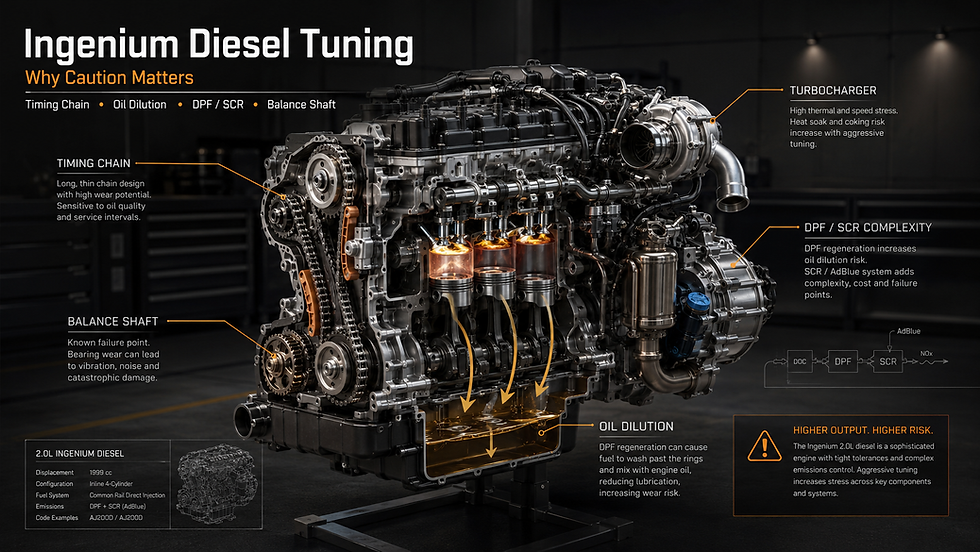
However, certain 2.0-litre Ingenium diesel applications have documented timing-chain, balance-shaft and emissions-system concerns. These issues become highly relevant when ECU calibration is used to increase boost pressure, injected fuel quantity, cylinder pressure and torque.
Jaguar Land Rover's own technical documentation confirms timing-chain elongation on affected AJ20D4 applications, while separate manufacturer service information documents balance-shaft concerns and DEF/SCR-related faults on specific vehicles.
For that reason, we do not regard the 2.0 Ingenium diesel as an ideal platform for blindly chasing maximum advertised “Stage 1” torque.
Some engines can be tuned conservatively.
Some should remain standard.
And some should be repaired before performance tuning is even considered.
What Is the Jaguar Land Rover Ingenium Engine?
Ingenium was developed as Jaguar Land Rover's modular engine family, initially appearing as four-cylinder diesel engines before expanding into petrol and later six-cylinder applications.
The architecture was designed around approximately 500 cc per cylinder and incorporated modern technologies intended to reduce friction, improve combustion efficiency and meet increasingly stringent emissions requirements.
Depending on engine generation and application, Ingenium technology includes:
aluminium-intensive construction;
direct fuel injection;
turbocharging;
variable camshaft control;
electronically managed lubrication;
advanced thermal management;
balance shafts on four-cylinder applications;
Exhaust Gas Recirculation;
Diesel Particulate Filtration;
Selective Catalytic Reduction;
AdBlue/DEF dosing;
multiple exhaust-temperature and emissions sensors.
This is technologically sophisticated engineering.
It also means that the engine, turbocharger, lubrication system and exhaust aftertreatment cannot be considered independently.
A fault in one part of the system can affect several others.
Why We Are Particularly Cautious With the 2.0 Ingenium Diesel
Our principal concern is not the entire Ingenium family.
It is specifically certain 2.0-litre Ingenium diesel applications, particularly where maintenance history, oil condition, DPF regeneration history and mechanical condition are unknown.
These engines can deliver substantial torque from only two litres of displacement.
That makes them pleasant road engines when operating correctly, but it also means considerable mean effective cylinder loading is already present in standard form.
Increasing torque further reduces the remaining engineering margin.
Factory Power Levels Are Important
Various 2.0 Ingenium diesel applications were sold at different output levels.
Examples include approximately:
163 PS / 380 Nm;
180 PS / 430 Nm;
240 PS / 500 Nm.
At first glance, this creates an obvious temptation:
If Jaguar Land Rover sells a 240 PS 2.0 Ingenium, why not simply tune a lower-output version to the same figure?
Because engine displacement alone does not establish hardware equivalence.
Jaguar specifically described the 240 PS / 500 Nm version as a strengthened engine, incorporating uprated pistons, crankshaft and fuel injectors together with sequential twin turbocharging.
Land Rover also documented the higher-output Sd4 with a series-sequential twin-turbo system and a 2,200-bar common-rail injection system.
That is extremely relevant to aftermarket tuning.
JLR itself did not simply take every lower-output engine and rely on calibration alone to create the factory 240 PS specification.
A D180 Is Not Automatically a Software-Limited D240
This is one of the most important points in this article.
The existence of a factory 240 PS engine does not prove that a D180 or other lower-output derivative is merely electronically restricted.
Nor does it prove that a lower-output engine cannot produce similar peak power after modification.
What it proves is something more precise:
Jaguar Land Rover introduced hardware changes when engineering its higher-output factory version.
Therefore, claims such as:
“They are all identical engines; just flash the D180 to D240 power.”
should be treated with considerable caution.
Before selecting tuning targets, the exact engine specification, turbocharger arrangement, fuelling hardware, transmission and model year should be identified.
Torque, BMEP and Why the Number Matters More Than Marketing Horsepower
Horsepower dominates advertising.
Torque tells us much more about the load being generated by an engine at a particular operating point.
A useful engineering parameter is Brake Mean Effective Pressure, or BMEP.
For a four-stroke engine:
BMEP = 4π × Torque / Displacement
For a 2.0-litre engine, approximately:
380 Nm = 23.9 bar BMEP
430 Nm = 27.0 bar BMEP
500 Nm = 31.4 bar BMEP
550 Nm = 34.6 bar BMEP
Moving from 430 Nm to 500 Nm therefore represents approximately a 16.3% increase in BMEP.
BMEP is not the same as peak cylinder pressure.
Peak firing pressure depends on factors including:
injection timing;
combustion phasing;
boost;
EGR fraction;
air-fuel ratio;
charge temperature;
compression ratio;
injection rate.
Nevertheless, BMEP provides a useful indication of how hard an engine is working relative to its displacement.
More torque means more load must ultimately be transmitted through:
pistons;
gudgeon pins;
connecting rods;
crankshaft;
main bearings;
big-end bearings;
cylinder-head sealing;
dual-mass flywheel;
torque converter or clutch;
gearbox;
transfer case and driveline.
A large low-RPM torque spike can therefore be much more mechanically significant than an impressive peak horsepower figure near the top of the rev range.
DPF Regeneration and Engine-Oil Dilution
One of the most important subjects surrounding modern diesel engines is the interaction between the Diesel Particulate Filter and engine lubrication.
A DPF captures particulate matter produced during diesel combustion.
As soot loading increases, the filter eventually requires regeneration.
The soot must be oxidised at sufficiently high temperature.
When natural exhaust temperature is insufficient, the ECU can initiate an active
regeneration strategy.
How Post-Injection Can Dilute Engine Oil
One method used by modern diesel engines to increase exhaust temperature involves late in-cylinder fuel injection.
Unlike the principal combustion injection event, this post-injection takes place much later in the cycle.
Under certain conditions, part of this fuel can impinge on the cylinder wall.
The piston and ring package can then transport a proportion of this fuel into the crankcase.
The result is:
diesel fuel mixed with engine oil.
This is not unique to Jaguar Land Rover.
It is a well-established engineering consequence of late post-injection strategies used during DPF regeneration.
Peer-reviewed research shows that post-injected fuel can wet the cylinder wall, pass through the piston-ring region and dilute the sump oil. Research also shows that delayed post-injections can significantly increase oil dilution and reduce the lubricant's tribological performance.
Why Oil Dilution Matters
Engine oil is not simply there to make components slippery.
A highly loaded engine bearing relies on a controlled lubricant film separating two metal surfaces.
Oil viscosity and film strength are therefore critical.
Fuel contamination can alter:
viscosity;
lubricant-film thickness;
volatility;
oxidation behaviour;
additive performance;
wear protection.
Research into diesel post-injection specifically identifies fuel dilution as a durability concern because deterioration of oil properties can compromise lubrication and increase component wear.
This becomes especially relevant when tuning.
Consider the combination:
higher torque + higher cylinder pressure + increased bearing load + degraded lubricant
That is exactly the situation in which the safety margin is moving in the wrong direction.
Short Journeys and Interrupted DPF Regeneration
Short-distance diesel operation deserves particular attention.
A diesel used repeatedly for:
short journeys;
low-speed urban driving;
repeated cold starts;
low exhaust-temperature operation
may spend less time in conditions favourable to successful DPF regeneration.
An interrupted regeneration does not somehow continue injecting fuel after the engine is switched off.
That would be technically incorrect.
The more relevant concern is cumulative regeneration demand.
If a regeneration cannot be completed, another regeneration may subsequently be required.
Greater cumulative post-injection activity means greater opportunity for fuel to enter the lubricant.
For customers whose vehicles are predominantly used for low-speed, short-duration journeys, diesel aftertreatment condition should therefore be checked particularly carefully before tuning.
Ingenium Timing-Chain Concerns
Timing-chain condition is one of the most important mechanical checks on the 2.0 Ingenium diesel.
And unlike many internet claims surrounding engine reliability, this one has direct manufacturer documentation behind it.
Jaguar Land Rover technical information covering 2017MY-onward XE, XF, F-PACE and Range Rover Velar models fitted with AJ20D4 describes a loose timing chain and states that the primary chain tensioner may be unable to control an elongated chain correctly.
The same JLR technical material refers technicians to a diagnostic procedure for a stretched timing chain.
That allows us to make a very specific statement:
Timing-chain elongation is a documented condition on affected AJ20D4 applications.
It does not mean:
Every Ingenium diesel will suffer timing-chain failure.
Those are completely different claims.
Why Timing Condition Matters Before Tuning
A timing system controls the relationship between crankshaft and camshaft position.
Excessive chain elongation or insufficient tension control can produce:
timing deviation;
rattling;
cam/crank correlation faults;
poor running;
reduced timing accuracy;
eventually severe mechanical failure if control is lost.
No ECU remap can repair a mechanically compromised timing system.
If an Ingenium displays timing-chain noise or diagnostic evidence of timing-system deterioration, performance tuning should stop until the mechanical problem has been repaired.
Ingenium Balance-Shaft Concerns
Four-cylinder engines naturally generate second-order vibration.
Balance shafts are commonly used to counteract this vibration and improve refinement.
The Ingenium four-cylinder diesel uses balance shafts for this purpose.
Jaguar Land Rover issued technical information concerning an audible engine whine on affected 2.0 Ingenium diesel vehicles and linked the condition to the balance-shaft system.
JLR Service Action N128 included a procedure which, when diagnosis confirmed the condition, required replacement of the balance-shaft assembly.
Again, the correct interpretation is important.
This proves a documented balance-shaft concern on affected engines.
It does not establish that every balance-shaft assembly will fail.
Nevertheless, an engine exhibiting abnormal balance-shaft noise is clearly not an appropriate candidate for increased power.
Turbocharger Loading After ECU Tuning
Turbocharger operation is frequently oversimplified in aftermarket tuning.
A common assumption is:
more boost = more power
but the engineering relationship is considerably more complicated.
Increasing requested charge pressure can increase:
compressor pressure ratio;
compressor discharge temperature;
turbocharger shaft-speed requirement;
turbine energy requirement;
exhaust manifold pressure;
turbine temperature;
intercooler heat rejection.
The actual operating point depends on:
corrected air mass;
compressor pressure ratio;
compressor efficiency;
turbine pressure ratio;
exhaust-gas enthalpy;
wastegate or VGT control;
engine speed;
ambient conditions.
Therefore:
More boost does not automatically mean turbocharger overspeed.
But increasing boost can move the turbocharger closer to compressor, turbine, temperature or shaft-speed limits.
Without access to the relevant compressor and turbine maps—or actual turbo-speed measurement—a competent tuner should retain appropriate margin rather than simply pursuing the highest possible boost target.
Fuel Quantity Is Not Free Torque
Increasing diesel torque normally requires additional fuel mass.
But additional injected fuel must still combust correctly.
Fuel quantity must remain compatible with:
available oxygen;
injection duration;
injection timing;
rail pressure;
cylinder pressure;
smoke limitation;
turbine temperature;
DPF loading.
Simply increasing injected quantity until the dyno produces the desired torque is not sophisticated calibration.
Poor Calibration Can Increase Soot
It would be incorrect to state that:
“Remapping automatically creates more soot.”
A properly engineered calibration should maintain sensible combustion and smoke-control limits.
However, if injected fuel is increased beyond what available oxygen and combustion duration can support efficiently, particulate formation can increase.
The DPF must then capture the additional soot.
That can increase regeneration demand.
The correct statement is therefore:
A poorly calibrated increase in fuelling can increase particulate formation and place additional demand on the DPF regeneration system.
Rail Pressure: More Is Not Automatically Better
Another common tuning misconception is that higher common-rail pressure automatically means better performance.
Rail pressure influences:
injection mass flow;
atomisation;
spray penetration;
injection duration;
mixture formation;
combustion rate.
Increasing rail pressure can sometimes assist calibration objectives.
It also increases demands on:
high-pressure pump;
fuel rail;
injectors;
pressure-control hardware.
Therefore increased rail pressure should only be used where the calibration requires it.
It should not be increased simply because a tuner has located the rail-pressure maps.
Injection Timing and Peak Cylinder Pressure
Injection timing is particularly important on a high-torque diesel.
Advancing combustion phasing can improve thermal efficiency.
However, excessive advancement can increase:
peak cylinder pressure;
pressure-rise rate;
combustion noise;
NOx production;
mechanical loading.
Retarded combustion can reduce some pressure effects but may increase:
exhaust-gas temperature;
turbine thermal load;
fuel consumption.
There is no free adjustment.
Every calibration decision moves the load somewhere else.
EGR, SCR, AdBlue and the Ingenium Emissions System
The Ingenium diesel's emissions-control strategy is sophisticated.
Jaguar Land Rover describes applications using both:
cooled low-pressure EGR;
high-pressure EGR;
together with:
DPF aftertreatment;
Selective Catalytic Reduction;
AdBlue/DEF dosing.
JLR explains that the dual EGR arrangement is used to reduce pumping losses and combustion temperatures, helping control NOx formation, while SCR uses DEF to convert NOx into nitrogen and water.
This means the emissions system is not simply a collection of components bolted onto the exhaust.
It is integrated into engine management.
Documented DEF/SCR Concerns
JLR has also published technical information relating to DEF/SCR malfunction warnings on affected Ingenium 2.0 diesel vehicles.
Service Action H152 covered certain F-PACE, XE and XF applications displaying a Diesel Exhaust Fluid malfunction warning and specified PCM software updating as part of the corrective action.
Separate JLR technical guidance for AJ20D4 applications lists potential causes of DEF/SCR-related warnings including:
NOx sensor malfunction;
intake or exhaust faults;
DPF or SCR catalyst faults;
DEF injector malfunction;
dosing-pump faults;
electrical failures.
Again, this does not mean every Ingenium AdBlue system is defective.
It demonstrates how many interconnected components must operate correctly before performance tuning is sensible.
Why Emissions-System Faults Should Be Repaired, Not Hidden
A professional ECU calibration should never be used as a substitute for mechanical diagnosis.
If a vehicle arrives with:
DPF faults;
EGR faults;
DEF faults;
NOx-sensor faults;
boost-control faults;
rail-pressure faults;
the first task is diagnosis.
Not tuning.
Disabling diagnostic functions does not repair the component that generated the fault.
For road vehicles, emissions-control systems must also comply with the legislation applicable to the vehicle and jurisdiction.
The correct sequence is:
Diagnose → Repair → Verify → Baseline → Tune
Not:
Fault → Delete diagnostic function → Increase power
Why “Stage 1” Is Not an Engineering Standard
There is no universal engineering definition of Stage 1.
One tuning company may take a 180 PS engine to 200 PS.
Another may advertise 215 PS.
Another might aim significantly higher.
All may describe the product as:
Stage 1
The term tells us almost nothing about:
boost pressure;
cylinder pressure;
torque by RPM;
injection quantity;
rail pressure;
lambda;
smoke limitation;
EGT;
turbocharger operating point;
thermal protection;
gearbox torque intervention.
The quality of the calibration is determined by what has actually been changed and how the engine behaves—not by the marketing label.
Why Huge Low-RPM Torque Figures Are Not Automatically Good Tuning
Customers naturally enjoy strong low-speed torque.
It makes a diesel feel powerful immediately.
But aggressive low-RPM torque targets can require very high cylinder filling and injected fuel quantity.
This can create substantial loading through:
pistons;
connecting rods;
crankshaft;
bearings;
dual-mass flywheel;
torque converter or clutch;
transmission;
driveshafts.
This is especially important with an engine already producing approximately 430–500 Nm from only two litres.
A smooth torque curve that builds progressively can be much better engineering than a violent torque spike designed primarily to generate an impressive dyno number.
Our Recommended Pre-Tuning Inspection for a 2.0 Ingenium Diesel
An Ingenium diesel should not simply arrive at a workshop, receive an ECU flash and leave.
Before calibration we recommend establishing a genuine mechanical baseline.
Complete Diagnostic Scan
Check current and historical DTCs relating to:
engine management;
boost control;
rail pressure;
DPF;
EGR;
SCR;
NOx sensors;
temperature sensors;
oil pressure;
camshaft/crankshaft correlation.
Historical faults should be investigated rather than simply deleted.
Engine-Oil Condition
Check:
correct oil level;
unexpectedly rising oil level;
oil-service history;
correct lubricant specification;
signs of fuel contamination.
Where condition is uncertain, laboratory oil analysis can provide useful information regarding fuel dilution, viscosity and wear metals.
Timing-System Condition
Listen for abnormal timing noise during:
cold start;
hot idle;
low engine speed;
transient throttle operation.
Where diagnostic procedures permit, evaluate timing-chain condition and cam/crank correlation.
Any credible timing-system concern should stop the tuning process.
DPF Condition
Evaluate:
soot loading;
differential pressure;
regeneration history where available;
exhaust-temperature sensor plausibility;
regeneration frequency;
distance since regeneration.
A vehicle already experiencing abnormal DPF behaviour should be repaired first.
Turbocharger Operation
Log:
requested boost;
actual boost;
boost deviation;
actuator command;
airflow;
charge temperature.
Investigate:
abnormal turbo noise;
oil contamination;
actuator faults;
compressor damage;
excessive shaft movement where physical inspection is appropriate.
Fuel-System Performance
Compare:
requested rail pressure;
measured rail pressure;
pressure stability under load;
injector correction information where available.
An unstable fuel system should not be subjected to additional demand.
EGR and Airflow Plausibility
Evaluate whether commanded EGR operation and measured airflow are plausible.
Incorrect airflow data can corrupt:
smoke limitation;
boost control;
calculated load;
EGR control;
combustion management.
SCR and AdBlue System
Any active DEF, NOx-sensor or SCR faults should be resolved before tuning.
The emissions system should be working correctly in standard configuration before increasing engine output.
Cooling System
Check:
coolant level;
pressure integrity;
operating temperature;
radiator condition;
charge-cooler/intercooler performance where applicable.
A tuned engine normally rejects more heat.
A marginal cooling system can therefore become a serious limitation.
Standard-Software Datalog
Before changing calibration, perform a baseline log.
A healthy engine should demonstrate repeatable control of:
boost;
rail pressure;
airflow;
temperature;
torque request;
emissions parameters where accessible.
If the vehicle cannot produce clean data while standard, there is little justification for increasing its load.
When We Would Refuse to Tune an Ingenium Diesel
We would consider refusing or postponing performance calibration where the vehicle exhibits:
timing-chain rattle;
confirmed timing-chain elongation;
balance-shaft whine;
abnormal oil level;
significant fuel dilution;
excessive DPF differential pressure;
repeated regeneration problems;
active EGR faults;
active SCR or DEF faults;
NOx-sensor faults affecting aftertreatment;
unstable rail pressure;
turbocharger control deviation;
excessive smoke;
coolant loss;
oil-pressure concerns;
abnormal mechanical noise;
poorly documented maintenance history combined with other warning signs.
A remap cannot restore mechanical integrity.
Can the 2.0 Ingenium Diesel Be Tuned?
Yes.
That answer needs qualification.
A healthy Ingenium diesel with known maintenance history, correct emissions-system operation and sensible calibration targets can potentially be tuned conservatively.
But the correct question is not:
“Can we tune it?”
The correct question is:
“Is the additional performance worth consuming some of the remaining mechanical and thermal safety margin of this particular engine?”
Sometimes the answer is yes.
Sometimes it is no.
What About the 2.0 Ingenium Petrol?
The 2.0 Ingenium petrol should be considered separately.
It does not share the diesel's DPF post-injection oil-dilution mechanism in the form discussed above.
It also uses a different combustion strategy and has different failure modes and tuning considerations.
It is therefore technically incorrect to take every problem associated with the Ingenium diesel and apply it automatically to the petrol engine.
For petrol tuning, areas such as:
octane quality;
knock control;
ignition timing;
lambda;
charge-air temperature;
exhaust temperature;
cooling capacity;
turbocharger speed
become particularly important.
The correct approach remains the same:
identify the exact engine and hardware before deciding on calibration targets.
Is the Ingenium Engine “Weak”?
Calling every Ingenium engine weak is too simplistic.
There are multiple Ingenium generations, power outputs, vehicle installations and fuel types.
However, it is fair to say that certain 2.0 diesel applications have enough documented mechanical and aftertreatment concerns that we would not treat them as an ideal platform for maximum-output generic remapping.
This distinction matters.
We are not saying:
“Every Ingenium will fail.”
We are saying:
“A documented reduction in reliability margin should influence how much additional load a responsible tuner is prepared to introduce.”
That is an engineering judgement rather than marketing.
The D240 Provides an Important Lesson for Tuners
Perhaps the most revealing fact comes from Jaguar Land Rover itself.
When JLR introduced the 240 PS / 500 Nm version, Jaguar explicitly described it as a strengthened engine using uprated pistons, crankshaft and injectors.
The higher-output Land Rover application also incorporated sequential twin turbocharging and a 2,200-bar common-rail system.
This should immediately make a professional calibrator cautious about claims that every lower-output Ingenium can simply be mapped to the largest available factory or aftermarket figure because:
“It is the same 2.0 engine.”
Displacement is only one specification.
The hardware matters.
Why Reliability Matters More Than a Dyno Number
A large dyno figure takes seconds to photograph.
Long-term durability can take years to evaluate.
The best calibration is therefore not necessarily the one producing the highest peak output.
A responsible road calibration should retain sensible margins for:
combustion pressure;
turbocharger operation;
fuel-system capability;
exhaust temperature;
coolant temperature;
smoke control;
gearbox torque;
DPF function;
engine protection strategies.
In many applications, reducing the torque spike while producing smooth, progressive power results in a much better vehicle.
Final Verdict: Should You Tune a Jaguar or Land Rover 2.0 Ingenium Diesel?
Our position is straightforward.
The 2.0 Ingenium diesel is not inherently untunable.
But neither is it a platform we recommend tuning blindly.
Jaguar Land Rover documentation confirms timing-chain elongation on affected AJ20D4 applications.
JLR also documented balance-shaft concerns requiring replacement on affected 2.0 diesel vehicles.
The diesel's emissions architecture includes sophisticated EGR, DPF and SCR/AdBlue systems, with manufacturer service information documenting DEF/SCR-related faults on certain vehicles.
Separately, diesel-engine research confirms that late post-injection used for DPF regeneration can dilute engine oil and compromise lubricant properties.
And perhaps most importantly for tuners, Jaguar itself strengthened the pistons, crankshaft and injectors when developing its factory 240 PS / 500 Nm high-output version.
Taken together, these facts justify caution.
For us, the correct procedure is:
Diagnose the engine.
Check the oil and timing system.
Verify the turbocharger and fuel system.
Assess the DPF, EGR and SCR system.
Perform a standard-software baseline datalog.
Identify the exact hardware specification.
Then decide whether additional torque is justified.
The objective should never be the largest number advertised on a tuning database.
The objective should be a calibration the engine can realistically live with.
And sometimes the most professional tuning decision is to leave the engine standard.
Frequently Asked Questions About Ingenium Engine Tuning
Can a Jaguar 2.0 Ingenium diesel be remapped?
Yes, a mechanically healthy engine can potentially accept a conservative ECU calibration. Mechanical condition, timing-chain health, DPF operation, oil condition, turbocharger performance and fuel-system stability should be established first.
Is the Ingenium diesel timing-chain problem real?
JLR technical documentation confirms elongated or stretched timing-chain conditions on affected AJ20D4 applications. This does not mean every engine will experience the problem.
Does DPF regeneration dilute engine oil?
Late in-cylinder post-injection used during active DPF regeneration can result in fuel reaching the cylinder wall and entering the sump through the piston-ring region. This mechanism has been demonstrated extensively in diesel-engine research.
Is the D180 mechanically identical to the D240?
It should not be assumed to be. Jaguar explicitly described the 240 PS version as a strengthened engine with uprated pistons, crankshaft and fuel injectors, together with sequential twin turbocharging.
Does tuning automatically damage the DPF?
No. A properly calibrated increase in output does not automatically cause DPF failure. However, excessive fuelling or poor smoke control can increase particulate production and therefore increase the load placed on the DPF.
Should emissions faults be deleted during remapping?
No. An emissions-related diagnostic fault should first be investigated and the underlying mechanical, electrical or calibration problem corrected. Disabling fault monitoring does not repair the vehicle.
Is the Ingenium petrol engine just as problematic as the diesel?
The petrol engine should be considered separately. It uses a different combustion and aftertreatment strategy and should not automatically be assigned diesel-specific problems such as DPF-regeneration-related diesel fuel dilution.
What is the safest approach to Ingenium tuning?
Establish a standard baseline first, confirm the engine and aftertreatment systems are healthy, identify the exact hardware and then use conservative torque, boost, fuel and thermal targets rather than chasing the maximum advertised Stage 1 figure.


Comments