_edited_edited_pn.png)
Lambda Sensors Explained: How They Control Fuel Mixture, Performance and Emissions

Updated: Sep 20
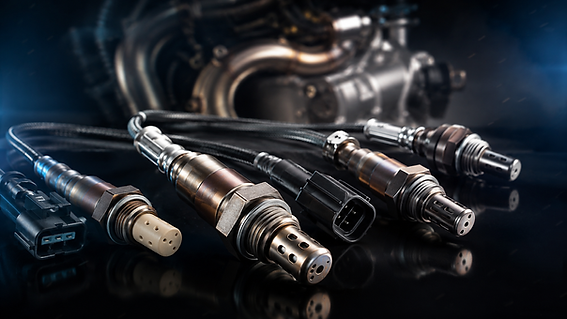
The lambda sensor, also known as an oxygen sensor or O2 sensor, is one of the most important components in a modern engine-management system.
Despite being relatively small, it provides the engine control unit with critical information about combustion. Its signal allows the ECU to correct the amount of fuel being injected, maintain efficient combustion, control emissions and protect the catalytic converter.
For engine diagnostics and performance tuning, lambda readings are equally important. They help us understand whether an engine is operating correctly, running too rich, running too lean or suffering from a mechanical, electrical or calibration-related problem.
However, a lambda sensor does not directly control the engine. It provides information to the ECU, and the ECU decides what corrections should be made.
What Does a Lambda Sensor Measure?
A lambda sensor measures the amount of residual oxygen present in the exhaust gases.
After combustion has taken place, the oxygen content in the exhaust gives an indication of whether the engine received too much fuel, too little fuel or approximately the correct amount.
The ECU compares this information with the desired target and adjusts the injector duration accordingly.
When there is too much oxygen in the exhaust, the mixture may be lean. This means there is proportionally more air and less fuel.
When there is very little oxygen remaining, the mixture may be rich, meaning that proportionally more fuel has been supplied.
It is important to understand that the lambda sensor does not simply measure fuel. It measures oxygen, from which the engine-management system calculates the condition of the air-fuel mixture.
Why Is It Called a Lambda Sensor?
Lambda is represented by the Greek letter λ and describes the relationship between the actual air-fuel mixture and the chemically ideal, or stoichiometric, mixture.
A lambda value of 1.00 means the engine is operating at the stoichiometric ratio for the fuel being used.
For conventional petrol, this is approximately 14.7 parts of air to one part of fuel by mass. However, that figure changes depending on the fuel. Ethanol blends, methanol and other fuels have different stoichiometric air-fuel ratios.
This is one reason why professional tuners often work with lambda rather than only using an air-fuel ratio figure.
The basic interpretation is:
Lambda 1.00: Stoichiometric mixture
Lambda below 1.00: Richer mixture
Lambda above 1.00: Leaner mixture
A lambda value is therefore more universal because it describes the mixture relative to the correct stoichiometric ratio for that particular fuel.
A Brief History of the Lambda Sensor
The development of the automotive lambda sensor was closely connected to increasingly strict exhaust-emission regulations, particularly in the United States during the late 1960s and early 1970s.
Bosch began developing an exhaust-gas oxygen sensor in 1969. The objective was to provide an electronic fuel-injection system with the feedback required to maintain the correct mixture for a three-way catalytic converter.
The first large-scale production application arrived in 1976, when Volvo installed Bosch lambda sensors on 240 and 260 series vehicles intended for the American market.
This was a major development in engine management. A three-way catalytic converter requires the mixture to remain extremely close to lambda 1 in order to efficiently reduce carbon monoxide, hydrocarbons and nitrogen oxides.
Without continuous feedback from the lambda sensor, early electronic injection systems could not regulate the mixture accurately enough under all driving conditions.
Heated lambda sensors followed during the 1980s. The integrated heater allowed the sensor to reach its operating temperature much more quickly after a cold start. Bosch later introduced more advanced planar and wideband sensor technology, providing faster response and a much wider measuring range.
How Does a Lambda Sensor Work?
Most traditional lambda sensors use a ceramic sensing element made primarily from zirconium dioxide.
One side of the element is exposed to the exhaust gas, while the other is exposed to a reference oxygen source. At a sufficiently high temperature, the difference in oxygen concentration produces an electrical signal.
The ECU reads this signal and determines whether the mixture is moving rich or lean.
When the engine is operating in closed-loop control, the ECU continuously adjusts the injected fuel according to the lambda sensor signal. The mixture moves slightly rich and slightly lean around the target point as the ECU makes constant corrections.
During certain operating conditions, such as cold starting, full-load acceleration, catalyst heating or some protection strategies, the engine may operate in open loop. In this state, the ECU relies more heavily on programmed fuel maps and other sensor inputs instead of normal closed-loop correction.
Modern strategies are more complex, and some engines continue to use wideband lambda feedback over a much larger portion of the operating range.
Narrowband and Wideband Lambda Sensors
There are two main categories of lambda sensor used in petrol-engine applications.
Narrowband Lambda Sensors
A conventional narrowband sensor is sometimes called a switching sensor.
It is designed primarily to identify whether the mixture is richer or leaner than lambda 1. Its signal changes sharply as the mixture passes through the stoichiometric point.
This makes a narrowband sensor suitable for controlling a three-way catalytic converter during normal driving. However, it cannot accurately report how rich or how lean the engine is once the mixture moves significantly away from lambda 1.
For example, a narrowband sensor may indicate that the engine is running rich, but it cannot reliably distinguish between a mildly rich mixture and the substantially richer mixture required under high boost.
Wideband Lambda Sensors
A wideband lambda sensor can measure the mixture accurately across a much greater range.
It normally uses a measuring cell, a pump cell and dedicated control electronics. Instead of simply switching between rich and lean, it allows the ECU or an external controller to calculate a precise lambda value.
Bosch describes the wideband sensor as capable of determining oxygen concentration over a wide range so that the air-fuel ratio in the combustion chamber can be calculated.
Wideband sensors are essential for modern direct-injection engines, turbocharged engines, diesel applications, emissions control and professional ECU calibration.
When tuning a performance engine, a correctly installed and calibrated wideband sensor is one of the most important pieces of measuring equipment available.
Pre-Catalyst and Post-Catalyst Sensors
Modern vehicles often use more than one lambda sensor.
The pre-catalyst sensor, also called the upstream sensor, is installed before the catalytic converter. It is normally the main sensor used by the ECU to monitor and correct the air-fuel mixture.
The post-catalyst sensor, or downstream sensor, is installed after the catalytic converter. Its primary purpose is usually to monitor catalyst efficiency.
A healthy catalytic converter stores and releases oxygen while processing the exhaust gases. As a result, the downstream sensor signal should normally be more stable than the upstream signal.
If the downstream signal begins to closely follow the upstream sensor, the ECU may determine that the catalytic converter is no longer operating efficiently.
This can produce faults such as a catalyst-efficiency code, but it does not automatically prove that the catalytic converter itself is defective. Exhaust leaks, engine misfires, incorrect fueling and damaged lambda sensors can all produce misleading results.
Why Lambda Sensors Matter in Performance Tuning
Lambda information is fundamental when calibrating a performance engine.
Under higher engine load, particularly on a turbocharged or supercharged engine, the correct mixture is necessary to control combustion temperature, exhaust-gas temperature and knock tendency.
A mixture that is excessively lean under load can increase combustion temperatures and the risk of detonation, pre-ignition or component damage.
However, simply adding excessive fuel is not a professional solution. An unnecessarily rich mixture can reduce power, contaminate the engine oil, increase fuel consumption, damage the catalytic converter and create excessive exhaust deposits.
The correct target depends on the engine design, fuel, boost pressure, combustion system, exhaust-gas temperature, ignition timing and intended use of the vehicle.
This is why a performance calibration should never be based on lambda readings alone. The tuner should also evaluate ignition correction, knock activity, boost pressure, fuel pressure, injector demand, intake temperature, exhaust temperature and other relevant engine data.
Can a Lambda Reading Prove the Mixture Is Correct?
Not always.
A lambda sensor reports the oxygen content present in the exhaust at its installation point. Several faults can cause a misleading reading.
For example, an exhaust leak before the sensor can allow outside air to enter the exhaust system. The additional oxygen may make the sensor report a lean condition even if the engine is receiving enough fuel.
A misfiring cylinder can create a similar problem. Because the mixture has not burned correctly, unused oxygen passes into the exhaust. The lambda sensor may interpret this as a lean mixture, even though adding more fuel would make the misfire worse.
Incorrect lambda readings may therefore be caused by:
Exhaust leaks
Ignition misfires
Low fuel pressure
Injector problems
Air leaks after the airflow meter
Incorrect airflow or pressure sensor readings
Engine mechanical problems
Wiring faults
Sensor contamination
Incorrect ECU calibration
A diagnostic technician must consider the complete system rather than replacing the sensor simply because a fault code mentions oxygen or mixture control.
Common Symptoms of a Failing Lambda Sensor
A defective or slow lambda sensor may produce several symptoms, including:
Increased fuel consumption
Rough idle
Poor throttle response
Hesitation during acceleration
Failed emissions testing
Increased exhaust emissions
Reduced engine performance
Strong fuel smell
Engine warning light
Rich or lean mixture fault codes
Catalytic-converter efficiency faults
In some cases, the vehicle may appear to drive normally while fuel consumption and emissions gradually increase.
A sensor can also become slow without failing completely. It may still produce a plausible signal, but its response is no longer fast enough for accurate mixture control.
What Can Damage a Lambda Sensor?
Lambda sensors operate in an extremely harsh environment. They are exposed to high exhaust temperatures, vibration, condensation, combustion deposits and rapid heating and cooling cycles.
Common causes of damage or contamination include:
Burning engine oil
Coolant entering the combustion chamber
Excessively rich running
Persistent engine misfires
Silicone contamination
Leaded fuel
Incorrect fuel additives
Physical impact
Damaged wiring
Poor electrical connections
Excessive exhaust temperature
Using unsuitable sealants near the intake or exhaust system can also contaminate certain sensor types.
Replacing a contaminated sensor without correcting the original engine fault will normally result in the new sensor becoming damaged as well.
Should a Lambda Sensor Be Cleaned?
Cleaning a lambda sensor is rarely a reliable professional repair.
The sensing element is delicate, and aggressive chemicals or mechanical cleaning can permanently damage it. Even when deposits appear to have been removed, the sensor’s response time and accuracy may remain incorrect.
The proper approach is to diagnose why the sensor became contaminated, repair the underlying fault and replace the sensor when necessary.
The replacement sensor must also be the correct specification. A sensor that physically fits the exhaust does not necessarily have the correct heater resistance, wiring configuration, signal type or calibration for the vehicle.
Correct Lambda Sensor Diagnosis
A proper diagnostic procedure should include more than reading fault codes.
Depending on the vehicle and sensor type, testing may involve:
Reading live lambda values
Checking short-term and long-term fuel corrections
Testing sensor response speed
Inspecting heater operation
Checking wiring and supply voltage
Looking for exhaust or intake leaks
Comparing upstream and downstream signals
Testing fuel pressure
Checking for engine misfires
Inspecting the condition of the spark plugs
Comparing readings with an external exhaust-gas analyser
Wideband sensors also require specific diagnostic knowledge. Their signals cannot always be tested in the same way as an older narrowband sensor.
The Lambda Sensor Is More Than an Emissions Component
It is easy to regard the lambda sensor as nothing more than an emissions-control device. In reality, it is a central part of modern engine management.
It affects fuel consumption, drivability, catalytic-converter operation, engine protection and diagnostic accuracy. In performance vehicles, accurate lambda measurement is also essential when validating an ECU calibration under real operating conditions.
At Torque Tuning in Marbella, we use professional diagnostics and datalogging to analyse the complete engine-management system. A mixture-related fault should never be approached by guessing or replacing parts unnecessarily. The lambda reading must be understood together with the engine’s fuel system, ignition system, airflow calculation and mechanical condition.
A sensor can provide valuable information, but only when that information is interpreted correctly.
Frequently Asked Questions
Is a lambda sensor the same as an oxygen sensor?
Yes. Lambda sensor, oxygen sensor and O2 sensor are different names commonly used for the same type of exhaust-gas sensor.
Can a faulty lambda sensor reduce performance?
Yes. Incorrect feedback may cause inappropriate fuel corrections, poor throttle response, increased fuel consumption and reduced performance. However, the underlying problem may also be elsewhere in the engine.
Does every car have two lambda sensors?
No. The number depends on the engine and exhaust configuration. Some vehicles have one, while modern multi-bank engines may use four or more.
Can removing a catalytic converter damage a lambda sensor?
Removing or changing the catalyst alters exhaust flow, temperature and downstream oxygen behaviour. It can create warning lights and diagnostic faults and may also make the vehicle illegal for public-road use.
Are lambda sensors used on diesel engines?
Yes. Modern diesel engines can use wideband lambda sensors as part of their combustion and emissions-control strategies.
Can a lambda sensor be used for tuning?
A professional wideband lambda system is an essential tuning tool, but it must be correctly installed and calibrated. Lambda data should always be assessed alongside ignition, boost, fuel pressure, knock control and other engine parameters.
Related technical guides
Relevant Torque Tuning services
For custom ECU calibration, datalogging and performance engineering, see our performance tuning services. To discuss your vehicle or project, contact Torque Tuning.


Comments