_edited_edited_pn.png)
Pop and Bang Maps Explained: The Hype, the Risks and What Owners Should Know

Updated: 5 minutes ago
Pop and bang map risks
Few ECU modifications divide opinion as strongly as the pop and bang map.
Some drivers love the aggressive crackles produced when lifting off the accelerator or changing gear. Others see them as unnecessary noise that can quickly turn a sophisticated performance car into something that sounds artificially modified.
The truth sits somewhere in the middle.
A correctly calibrated, restrained overrun sound strategy can add character without constantly abusing the vehicle. An aggressive map designed only to create the loudest possible explosions can overheat catalytic converters, shorten the life of turbochargers and damage expensive exhaust components.
The difference is not simply whether the car pops. It is how the effect is created, how aggressively it is calibrated and under which conditions it is allowed to operate.
What Is a Pop and Bang Map?
A pop and bang map—also called a crackle map or burble tune—is an ECU calibration that creates audible combustion events inside the exhaust system when the driver releases the accelerator.
During normal overrun, many modern petrol engines reduce or completely cut fuel injection. This improves fuel economy, reduces emissions and prevents unnecessary heat from entering the exhaust system.
To create crackles, the calibration can temporarily change the normal overrun strategy. Depending on the engine and ECU, it may allow a controlled quantity of fuel to remain while delaying ignition timing.
The delayed combustion transfers more energy into the exhaust. Some combustion finishes as the exhaust valves are opening, or unburned hydrocarbons react further inside the hot exhaust system.
Research into petrol-engine catalyst heating confirms that retarded ignition increases exhaust temperature and hydrocarbon emissions. Studies of automotive catalytic converters also show that increased misfire or afterburn can produce a rapid rise in exhaust-gas and catalyst temperature.
That rapid release of energy is what creates the familiar burble, crack or bang.
Factory Burble, Crackle Maps and Anti-Lag Are Not the Same
These terms are regularly confused, but they describe different strategies.
Factory overrun sound
Many modern performance cars leave the factory with controlled exhaust crackles in their sport or track modes.
The manufacturer has developed the engine software, catalytic converters, exhaust valves, silencers and thermal-protection strategies as one complete system. Activation may be restricted according to engine temperature, exhaust temperature, driving mode, engine speed, gear and time since the throttle was released.
A factory strategy is not automatically harmless, but it has normally been tested and limited around the original vehicle hardware.
Aftermarket pop and bang map
An aftermarket crackle map modifies the ECU calibration to increase the frequency, volume or duration of the exhaust sound.
A professional version should be adapted to the vehicle, its exhaust system and the owner’s requirements. A generic file may apply an unnecessarily aggressive strategy across a broad operating range without considering catalyst temperature, exhaust design or whether the car is using standard or modified hardware.
Motorsport anti-lag
A genuine anti-lag system is designed to maintain turbocharger speed when the driver closes the throttle. Its primary purpose is response and performance, not sound.
It can use substantially more aggressive ignition, fuelling and airflow strategies to generate energy in the exhaust manifold and keep the turbine rotating. The noise and flames are consequences of the system rather than its main objective.
A normal road-car crackle map rarely provides genuine anti-lag performance. In most cases, it makes noise without maintaining meaningful turbocharger speed.
Why Have Pop and Bang Maps Become So Popular?
Part of the attraction is emotional.
A performance car is not judged only by acceleration figures. Sound, throttle response and the way a car makes its driver feel are important parts of the experience.
Exhaust crackles have traditionally been associated with highly tuned engines, rally cars and competition vehicles. Modern supercars brought controlled overrun sounds into road cars, and social media then pushed the trend toward increasingly loud and dramatic calibrations.
For some owners, a small amount of burble makes the car feel more alive. For others, the objective becomes producing continuous machine-gun-style explosions every time the throttle is released.
That is where character can become abuse.
A good calibration should complement the vehicle. It should not make every journey sound like an attempt to attract attention.
Do Pop and Bang Maps Increase Power?
A conventional pop and bang map does not normally increase peak power.
The effect occurs primarily when the driver is reducing or closing the throttle, not when the engine is operating under full load and producing maximum torque.
An ECU remap can combine a performance calibration with an overrun sound strategy, but these are two different parts of the software. The increased power comes from correctly optimising boost control, ignition, fuelling, airflow and torque management—not from the bangs themselves.
A genuine motorsport anti-lag system can improve transient turbo response, but this should not be confused with a road-car crackle map.
The Real Pop and Bang Map Risks
The risk depends on the intensity of the calibration, how often it is used, the condition of the vehicle and the type of exhaust hardware installed.
A mild, temperature-controlled strategy is very different from a map that continuously sends fuel and late combustion into the exhaust.
Catalytic-converter damage
The catalytic converter is usually the component most exposed to an aggressive pop and bang map.
When unburned hydrocarbons reach the hot catalyst, they can oxidise inside the converter. This chemical reaction creates additional heat. Research on emissions-system durability confirms that engine misfire and ignition faults can send unburned hydrocarbons into the catalyst, where oxidation reactions increase its thermal load.
Automotive three-way catalysts commonly operate within a controlled temperature range. Research describes approximately 300°C to 800°C as a normal effective operating region, while catalyst temperatures above approximately 1,050°C can cause severe thermal ageing.
An aggressive calibration can cause:
Melting or deformation of the catalyst substrate
Cracking of the internal ceramic structure
Reduced emissions-conversion efficiency
Catalyst-efficiency fault codes
Increased exhaust restriction
Complete catalytic-converter failure
On a modern supercar, replacement catalytic converters can be extremely expensive.
Gasoline particulate filter damage
Many current direct-injection petrol engines use a gasoline particulate filter, normally called a GPF or OPF.
The filter is designed to capture particulate matter and operate within controlled thermal conditions. Repeated afterburn and excessive exhaust temperatures can increase thermal stress on the filter and its surrounding components.
Removing or disabling the GPF is not a responsible solution for a road vehicle. It changes the approved emissions configuration and can create legal, inspection and insurance problems.
Turbocharger heat and stress
On a turbocharged engine, the exhaust gas reaches the turbine before passing farther down the exhaust system.
Retarded combustion sends additional heat and energy toward the turbocharger. The turbine wheel, turbine housing, wastegate assembly and bearing system must therefore absorb thermal loads that may be higher than those produced during normal overrun.
Repeated high-temperature operation can contribute to:
Turbine-housing cracks
Wastegate wear
Accelerated bearing degradation
Oil carbonisation around the turbocharger
Heat damage to nearby wiring and hoses
Reduced turbocharger service life
The occasional mild factory-style crackle is not equivalent to a full motorsport anti-lag strategy. However, the more aggressive and prolonged the calibration becomes, the closer the exhaust hardware moves toward competition-level thermal stress without necessarily having competition-grade components.
Exhaust-manifold and gasket damage
Exhaust manifolds are designed to handle high temperatures, but they are not intended to function as uncontrolled combustion chambers.
Repeated pressure waves and rapid thermal cycling can place additional stress on:
Exhaust-manifold runners
Manifold gaskets
Flexible exhaust sections
V-band clamps
Welded joints
Downpipes
Heat shields
Thin-wall stainless-steel manifolds and aftermarket systems with poor-quality welds can be particularly vulnerable.
Silencer and resonator damage
A loud bang is a pressure event inside the exhaust.
Repeated aggressive events can loosen internal silencer material, damage perforated tubes, crack baffles or accelerate wear inside resonators.
Exhaust systems using lightweight construction can sound excellent but may not be designed to withstand continuous explosions inside the rear silencers.
Oxygen sensors and exhaust-temperature sensors
Modern engines use several sensors to control fuelling and monitor emissions-system performance.
Excessive heat can shorten the service life of oxygen sensors and exhaust-temperature sensors. Poor calibration may also produce misleading readings, fault codes or adaptation problems.
Simply switching off the relevant diagnostic trouble codes does not repair the underlying thermal problem. It only prevents the driver from being warned about it.
Exhaust-valve temperature
Very late combustion can expose the exhaust valves and valve seats to increased temperature.
This does not mean that every crackle map will burn an exhaust valve. However, a highly aggressive strategy that is used frequently can reduce the safety margin engineered into the original engine.
The risk becomes more serious when the engine is already modified, running higher boost, operating with elevated exhaust temperatures or suffering from an existing fuelling or ignition problem.
Fuel consumption and oil dilution
A crackle map that continues injecting fuel during overrun will use more fuel than the standard fuel-cut strategy.
With extremely excessive fuelling, some fuel may fail to burn cleanly. Depending on the engine design and operating conditions, repeated poor combustion can contribute to fuel contamination of the engine oil.
This is another reason why adding more fuel does not automatically create a better-sounding or safer result.
Can Pop and Bang Maps Cause a Fire?
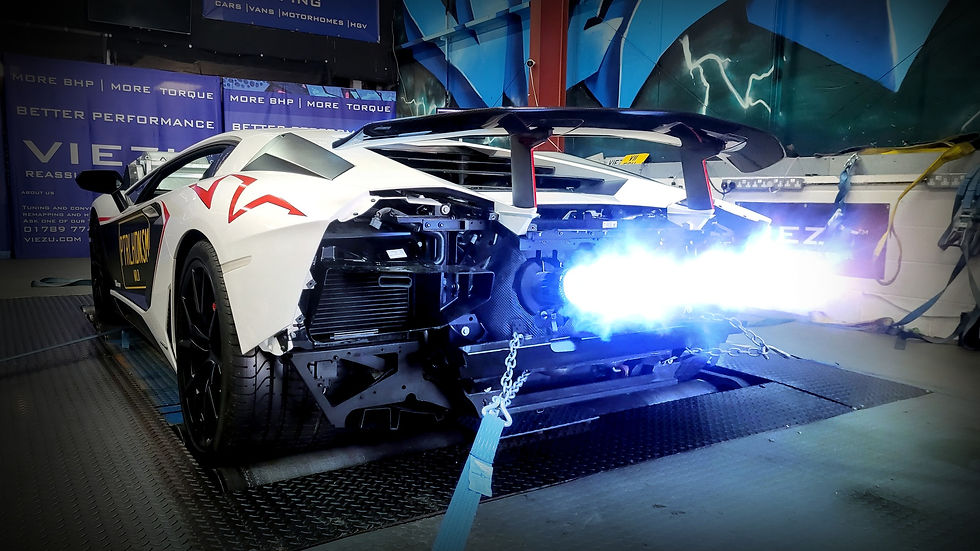
Visible flames from the exhaust may look impressive in a video, but they indicate that combustion energy is leaving the tailpipe.
An overheated catalytic converter or exhaust system can become hot enough to ignite dry vegetation or other combustible material beneath the vehicle. Vehicle manufacturers warn that abnormal catalyst overheating can create a fire risk when a car is driven slowly or parked over dry plants, wood or cardboard.
A road car regularly producing large flames should not be presented as a harmless cosmetic modification.
Are Pop and Bang Maps Legal in Spain?
Road legality depends on the vehicle, the modification and the level of noise and emissions produced.
Spanish traffic regulations prohibit vehicles from circulating when their noise, gases or smoke exceed the permitted limits. The rules also restrict unauthorised significant modifications and allow the authorities to immobilise a vehicle that exceeds regulated noise or emissions levels.
European vehicle approval rules also establish noise requirements for road vehicles and their exhaust systems.
An aggressive crackle map may therefore create problems involving:
Roadside noise enforcement
ITV inspection
Emissions testing
Vehicle homologation
Insurance coverage
Manufacturer warranty
Police complaints in residential areas
A vehicle passing a basic emissions check on one occasion does not automatically mean every part of its modified calibration is road legal.
Regulations and inspection practices can also vary, so the vehicle owner remains responsible for ensuring that the car complies with the applicable rules.
Will a Pop and Bang Map Void the Warranty?
Any non-approved ECU modification may affect the manufacturer’s warranty.
Modern dealerships can often identify programming history, software versions, flash counters or operating conditions that differ from the approved factory configuration.
Whether a particular claim is rejected will depend on the manufacturer, vehicle, market and relationship between the modification and the failed component. Nevertheless, owners should assume that an ECU remap can create warranty complications.
The same applies to aftermarket warranties and insurance policies. Material modifications should be declared where required.
Why Factory Pops Are Usually More Controlled
A manufacturer can integrate the sound strategy with the complete vehicle.
The ECU may stop the effect when:
The engine is cold
The catalytic converter is too hot
The exhaust temperature model reaches a limit
The vehicle is in its normal or comfort mode
Engine speed falls outside the permitted window
The effect has operated for too long
A component fault is detected
Research into catalyst-heating control demonstrates why ignition timing, fuelling, hydrocarbon emissions and catalyst temperature must be treated as connected variables rather than adjusted independently.
A poorly developed aftermarket file may remove some of these restrictions simply to produce a more dramatic result.
Louder does not mean better calibrated.
What Does a Responsible Pop and Bang Calibration Look Like?
A responsible calibration should be deliberately limited.
Depending on the vehicle and its intended use, this can include:
Activation only in a selected sport or track mode
A defined engine-speed window
A minimum engine-temperature requirement
Restrictions when exhaust temperatures are high
Short activation duration
Retention of normal fuel cut outside the selected area
No activation during cold starts
Reduced intensity with original catalytic converters
Protection for turbocharged engines
Switchable operation controlled by the driver
Verification through diagnostics and datalogging
The calibration must also match the exhaust system.
A car with original catalytic converters, particulate filters and silencers cannot automatically use the same strategy as a competition vehicle with a purpose-built exhaust.
When Should a Pop and Bang Map Be Avoided?
We would normally advise against an aggressive crackle strategy when the vehicle has:
Ageing or damaged catalytic converters
Existing catalyst-efficiency fault codes
A damaged or blocked GPF
Turbocharger problems
Excessive oil consumption
Misfires or ignition faults
Damaged exhaust valves
Poor-quality aftermarket exhaust components
Unknown ECU software
Existing tuning from an unidentified source
The mechanical condition of the vehicle must be established before adding further heat and stress.
No responsible tuner should use exhaust noise to hide an existing misfire, fuelling fault or damaged catalyst.
Our Honest View on Pop and Bang Maps
A small amount of controlled overrun sound can suit the right car.
A McLaren, Porsche, Lamborghini, Ferrari, BMW M or Mercedes-AMG can benefit from a sharper and more emotional exhaust character when the effect is properly integrated with its driving modes and exhaust hardware.
However, constant gunshot-style bangs are rarely sophisticated. They attract unwanted attention, create unnecessary thermal stress and can quickly become unpleasant during normal driving.
The best calibration is not the loudest one. It is the calibration that gives the owner the desired experience while maintaining sensible limits.
At Torque Tuning, we do not treat every vehicle in the same way. We assess the ECU, engine, turbochargers, catalytic converters, particulate filters and complete exhaust system before recommending an overrun strategy.
Where suitable, the effect can be made switchable and restricted to the correct driving mode, RPM range and operating conditions.
Based in Marbella and serving Puerto Banús, Sotogrande, Mijas and the wider Costa del Sol, Torque Tuning provides professional ECU calibration and performance solutions for premium, high-performance and supercars.
The objective is simple: create the right result for the car without sacrificing expensive components purely for noise.
Related technical guides
Relevant Torque Tuning services
For vehicle-specific calibration, diagnostics and performance engineering, see our performance tuning services. To discuss your vehicle or project, contact Torque Tuning.


Comments